Short answer: AI SEO means making your cabinet business easy for AI tools like ChatGPT, Claude, Muse AI, and Google AI Overviews to find, understand, and recommend. You do it with a fully optimized Google Business Profile, one clear page for every service and city you serve, reviews that name the service and the town, and consistent business details everywhere online. Do that well and the leads stop depending on whoever shouts loudest in ads. Homeowners asking AI “who are the best cabinet makers near me” start hearing your name.
Your next customer is asking an AI, not browsing a list
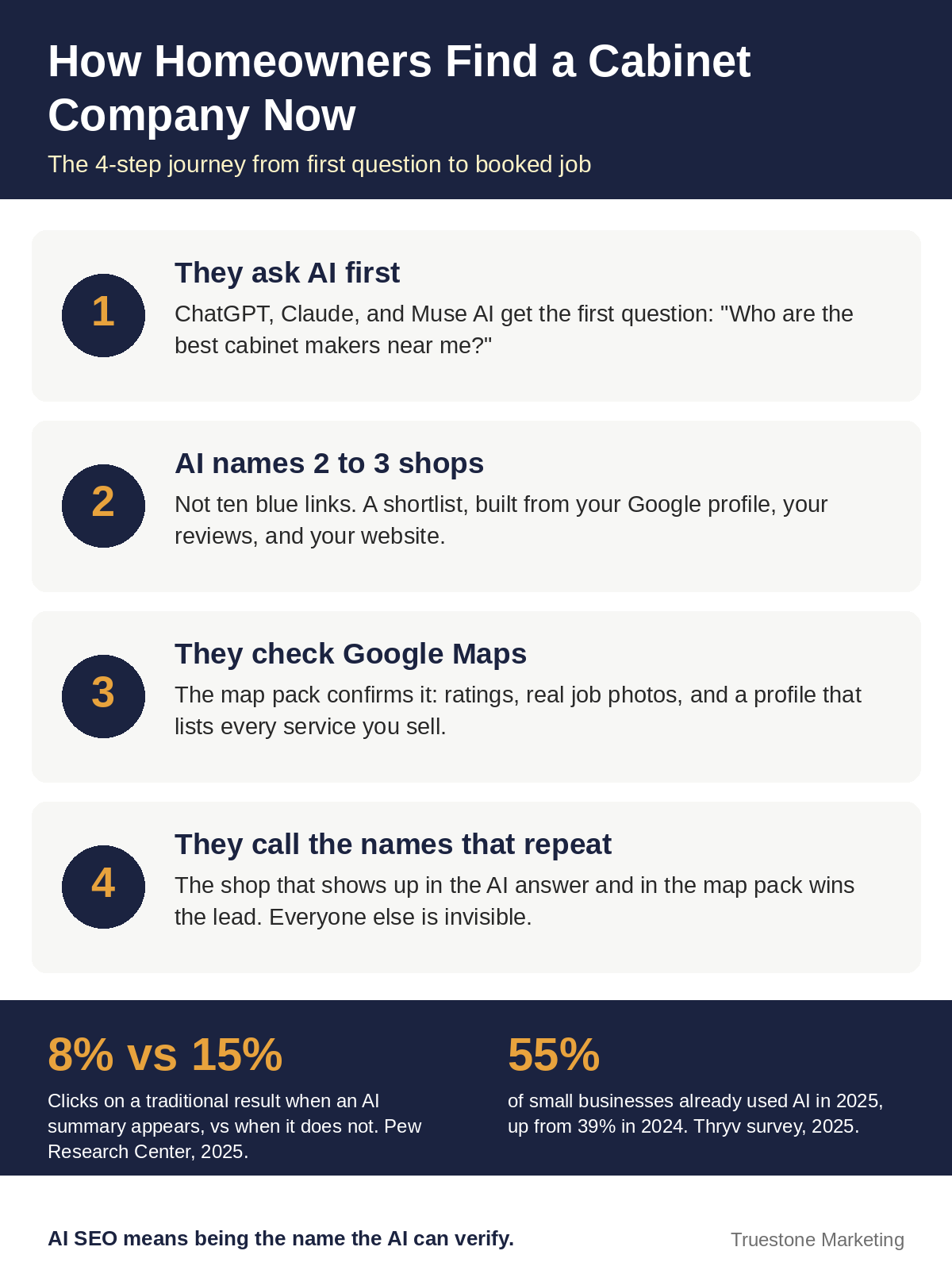
Think about how a kitchen remodel starts now. A homeowner in Houston or Phoenix sits on the couch, opens ChatGPT, and types: “We want new kitchen cabinets, budget around $25,000, who should we call?” The AI answers with two or three names. Not ten blue links. Two or three names.
If your shop is not one of them, you never even enter the conversation.
This is not a future trend. A May 2025 Pew Research Center study found that when a Google search showed an AI summary, only 8% of users clicked a traditional result, compared with 15% when no summary appeared, and just 1% clicked the links inside the summary itself. The click is dying. The recommendation is the new ranking. And a 2025 Thryv survey found 55% of small businesses already use AI in some part of their operation, up from 39% the year before. Your competitors are not waiting around, and neither are your customers.
What AI SEO actually means (SEO, AEO, and GEO in plain English)
You will hear three terms thrown around, so let me pin them down fast:
- SEO is classic search engine optimization: ranking on Google and Bing for searches like “custom cabinets Austin.”
- AEO, answer engine optimization, is about being the direct answer when someone asks a question, in Google AI Overviews, voice search, or a featured snippet.
- GEO, generative engine optimization, is about getting cited and recommended inside AI chat tools: ChatGPT, Claude, Muse AI from Meta, and Perplexity.
AI SEO is the umbrella. For a local cabinet business, all three run on the same fuel: clear facts about who you are, what you install, where you work, and proof that real customers were happy. AI tools do not guess. They repeat what they can verify.
Part 1: Google Maps and your Google Business Profile still run the show
Here is the thing most cabinet shops miss: AI tools lean heavily on local data, and the center of that data is your Google Business Profile. When a homeowner searches “cabinet makers near me” or asks an AI for a recommendation, the map pack and your profile are doing most of the heavy lifting.
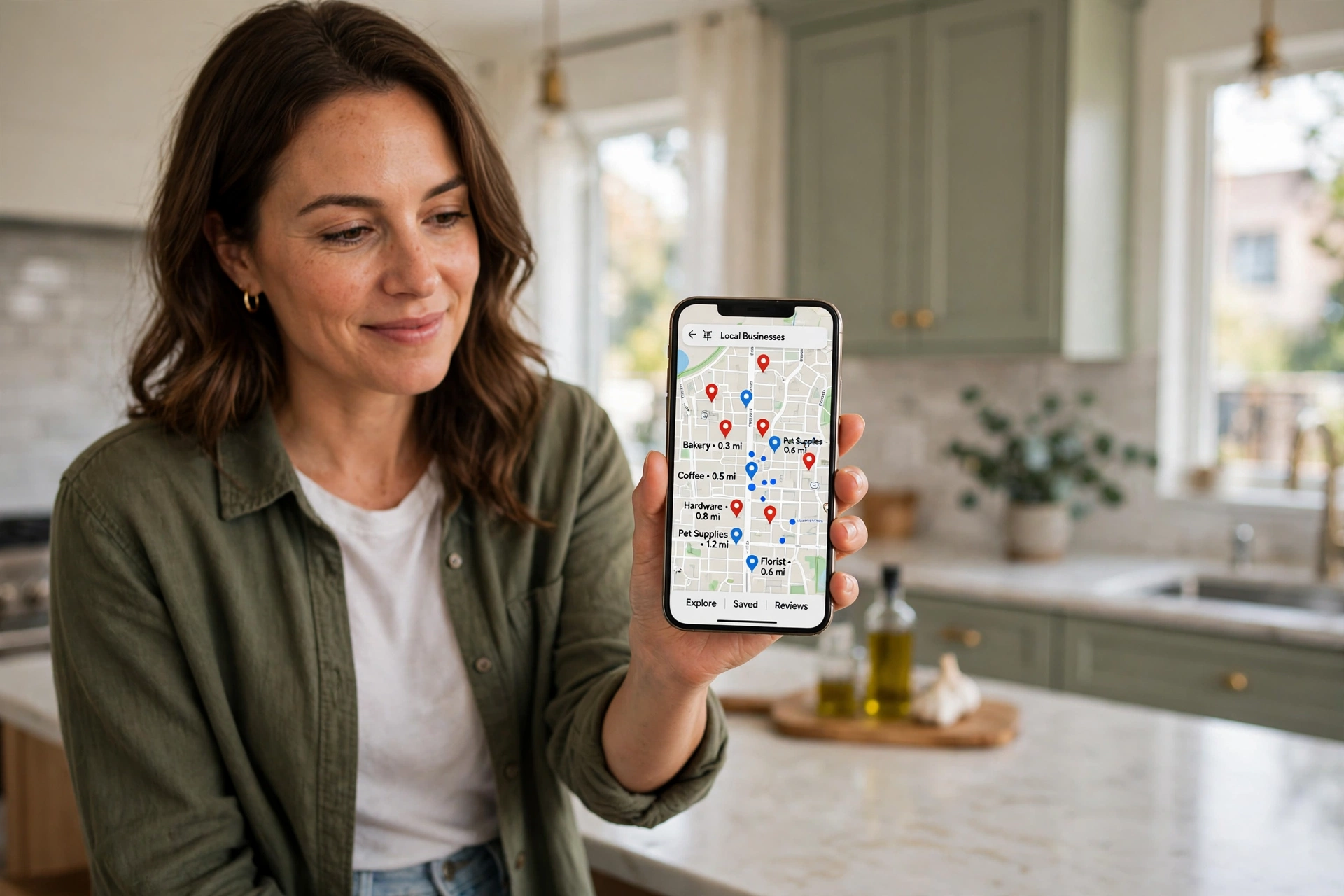
Set it up like a lead generation asset, not a listing you claimed once in 2019:
- Pick the right categories. Primary category should match your core business, such as Cabinet Maker, Cabinet Store, or Kitchen Remodeler. Add secondary categories for everything else you sell: bathroom vanities, cabinet refacing, cabinet refinishing, built-in cabinets, closet organization.
- List every service by name. Custom kitchen cabinets, semi-custom cabinets, cabinet installation, cabinet door replacement, Shaker cabinets, frameless cabinets, inset cabinets. AI reads service lists. A profile that just says “cabinets” is invisible next to one that spells it all out.
- Feed it photos weekly. Real job photos, before and afters, the showroom, the shop. Geotagged, recent, and captioned where the platform allows. Profiles that post fresh photos get more calls, and the images give AI tools more proof you are a real, active business.
- Use the Q&A section yourself. Seed the questions homeowners actually ask: “Do you offer free estimates?” “How long does a typical kitchen take?” “Do you serve Scottsdale?” Then answer them in plain sentences with your city names in the text.
- Keep hours, phone, and service areas exact. If you serve Dallas, Fort Worth, Arlington, and Plano, say so. AI cannot recommend a business it cannot place on a map.
One more point on reviews, because they matter more than ever. A five-star review that says “great job” tells an AI almost nothing. A review that says “They built our custom white oak kitchen cabinets in Tampa and finished two days early” gives the AI a service, a material, and a city to match against the next homeowner query. When you ask for reviews, ask happy customers to mention what you built and where. That one habit quietly powers both your map rankings and your AI recommendations.
Part 2: How to get recommended by ChatGPT, Claude, and Muse AI
Homeowners are asking all of these tools now: ChatGPT for research, Claude for comparing quotes and ideas, and Muse AI inside WhatsApp, Instagram, and Facebook, which matters because that is where a lot of homeowners already spend their time and share remodel photos with family. Each tool builds its shortlist a little differently, but the signals rhyme:
1. Be consistent everywhere. Your business name, address, and phone number must read identically on your website, Google, Bing Places, Yelp, Houzz, Angi, the BBB, and Facebook. ChatGPT leans on Bing and on directory data. Claude cross-checks sources against each other. When your details conflict, the tools lose confidence and name a competitor whose facts line up.
2. Get onto the lists AI reads. AI tools pull from “best of” roundups and directories constantly: “best cabinet companies in Atlanta,” Houzz pro listings, Yelp category pages, local chamber and home show features. If a list names five cabinet shops in Charlotte and you are not on it, no amount of website tweaking fixes that. Getting listed is old-school digital PR, and it is suddenly one of the highest-return AI SEO moves you can make.
3. Make your website the clearest source of your own facts. One page per service. One page per major city. Each page states plainly what the service is, what it typically costs, how long it takes, and where you offer it. Write the first sentence of each page as a direct answer, the way you would say it to a customer standing in your showroom. AI tools lift those sentences almost word for word.
4. Answer the money questions on your site. The highest-intent pages in cabinetry are cost pages. Homeowners ask AI what new kitchen cabinets cost before they ask who to hire. If your site has a clear page covering stock, semi-custom, and custom cabinet pricing, with honest ranges and what drives the price up or down, AI tools cite it, and the follow-up question becomes “who near me does this.” You want to already be the source they read.
5. Keep it fresh and dated. Put dates on your guides, update your galleries, post your recent projects. AI tools prefer sources that look current. A blog that stopped in 2022 reads like a business that closed.
Part 3: The keywords cabinet businesses should actually target
Forget chasing one giant keyword. Cabinet lead generation works on clusters: a money keyword, a place, and a service, combined. These are the clusters worth building pages and content around:
Ready-to-buy searches (highest lead value)
- custom cabinets near me
- cabinet makers in [city]
- kitchen cabinet company [city]
- cabinet installation [city]
- custom cabinetry near me
- cabinet showroom near me
Service keywords (one page each)
- custom kitchen cabinets
- semi-custom cabinets
- cabinet refacing
- cabinet refinishing and painting
- bathroom vanity cabinets
- built-in cabinets and bookcases
- closet cabinets and storage systems
- cabinet door replacement
Research questions (these feed AI answers and AEO)
- how much do custom kitchen cabinets cost
- cabinet refacing vs. replacing cabinets
- framed vs. frameless cabinets
- are custom cabinets worth the money
- how long does it take to build custom cabinets
- best cabinet company in [city] for a kitchen remodel
AI prompt style queries (the new frontier). Homeowners now type full sentences into ChatGPT and Muse AI: “Recommend a cabinet company in Nashville that does white oak cabinets and can start within two months.” You cannot rank for that sentence directly. What you can do is make sure the facts inside it, your materials, your city, your timelines, exist clearly on your site and profiles. That is what the AI assembles its answer from.
Part 4: City and state pages that actually bring leads
Cabinet work is hyper-local. Nobody ships a kitchen remodel across the country, so your AI SEO has to speak locally. The strongest cabinet markets in the US are also the most competitive: Texas (Houston, Dallas and Fort Worth, Austin, San Antonio), Florida (Miami, Orlando, Tampa, Jacksonville), Arizona (Phoenix and Scottsdale), California (Los Angeles, San Diego, Orange County), Georgia (Atlanta), North Carolina (Charlotte and Raleigh), Colorado (Denver), and Tennessee (Nashville).
For every city where you genuinely take work, build a dedicated page: “Custom Kitchen Cabinets in Austin” with two or three real projects from that city, a review from a homeowner there, neighborhoods you serve, and local details like permitting or popular home styles. A page per city with real proof beats a single “service areas” page every time, on Google, on Maps, and inside AI answers.
Do not build pages for cities you do not serve. AI tools and Google both punish thin copy-paste location pages, and a homeowner in Denver who books a design consult only to learn you are based in Georgia is a wasted lead for everyone.
What this looks like in practice
Say you run a cabinet shop serving the Dallas and Fort Worth area. A homeowner asks Muse AI in WhatsApp: “Who are the top-rated cabinet makers in Fort Worth for a full kitchen remodel?” For your name to come back, a chain of things has to be true at once. Your Google profile lists Fort Worth as a service area with custom kitchen cabinets as a named service. Your reviews mention Fort Worth remodels by name. Your site has a Fort Worth page with real jobs and pricing guidance. A Houzz or Yelp listing confirms the same phone number and categories. Each fact is small. Together they are the difference between being recommended and being invisible.

That is the whole game now. Not tricks, not hacks. Just being the easiest cabinet business in your market for an AI to verify and describe.
Mistakes that keep cabinet companies invisible in AI search
- Claiming a Google profile and never touching it again: no services, no photos, no replies to reviews.
- Different phone numbers or business names across directories, so AI tools cannot tell if you are one business or three.
- One generic “services” page instead of a page per service and per city.
- Reviews with no detail, or worse, asking staff and family to write them.
- Hiding prices completely. AI loves citing cost ranges. If you refuse to publish any numbers, a competitor’s guide becomes the answer and your name never enters the chat.
- A website that blocks AI crawlers or buries every fact inside images AI cannot read.
The bottom line
Cabinet buyers have not stopped searching. They have changed how they search. They ask ChatGPT, Claude, and Muse AI who to trust, they check the map pack on Google, and they call the two or three names that keep showing up. AI SEO is simply the work of being one of those names: an optimized Google Business Profile, city and service pages with real facts and real prices, consistent listings everywhere, and reviews that tell a story. Start with your profile and your top two cities. The shops that do this now will be the default answers in their markets while everyone else is still arguing about keywords from 2019.
Frequently Asked Questions
What is AI SEO for a cabinet business?
AI SEO is optimizing your cabinet company to be found and recommended by AI tools like ChatGPT, Claude, Muse AI, and Google AI Overviews, not just ranked in a list of links. It combines local SEO, answer engine optimization (AEO), and generative engine optimization (GEO), and it runs on clear service pages, an optimized Google Business Profile, consistent listings, and detailed customer reviews.
How do I get my cabinet company recommended by ChatGPT?
Make your business easy to verify. Keep your name, address, and phone identical on your website, Bing Places, Yelp, Houzz, and Google. Build one clear page for every service and city, publish honest cabinet cost guides, and collect reviews that name the service and the city. ChatGPT builds its shortlist from sources that agree with each other, so consistency and specifics win.
Does Google Business Profile matter for AI search, or only for Google Maps?
Both. Your Google Business Profile is a core data source for local recommendations across Google Maps, Google AI Overviews, and the wider web of directories that other AI tools read. Categories, services, photos, and reviews on your profile shape whether any AI names your shop when a homeowner asks for cabinet makers nearby.
What keywords should a cabinet company target first?
Start with ready-to-buy local terms: custom cabinets near me, cabinet makers in your city, kitchen cabinet installation in your city. Then build service pages for cabinet refacing, cabinet refinishing, semi-custom cabinets, and bathroom vanities. After that, publish answers to research questions like how much custom kitchen cabinets cost and refacing vs. replacing, because those feed AI answers and bring early-stage leads.
How long does AI SEO take to generate leads for a cabinet shop?
Profile and listing fixes can improve visibility within a few weeks. City pages, cost guides, and review momentum usually take 2 to 3 months to compound into steady AI recommendations and map pack leads. It is slower than ads at the start and much cheaper per lead once it is working, which is why most shops run both.
Can AI SEO replace Google Ads for cabinet lead generation?
Not entirely, and it does not have to. Ads buy immediate leads while AI SEO builds the recommendations that keep coming without a per-click cost. The strongest cabinet lead generation setups use ads for this month’s showroom appointments and AI SEO so that, six months from now, ChatGPT and Google Maps send leads that cost nothing per click.
Which AI tools should cabinet businesses care about most?
ChatGPT, because homeowners use it to research remodels and compare companies. Claude, because it is increasingly used to compare quotes and product options. Muse AI, because it lives inside WhatsApp, Instagram, and Facebook where homeowners already talk about their projects. And Google AI Overviews plus the Maps pack, because local intent still runs through Google first for most buyers.
Post Views: 28